Ninety Days Sounds Like a Deal — Run the Break-Even Math First

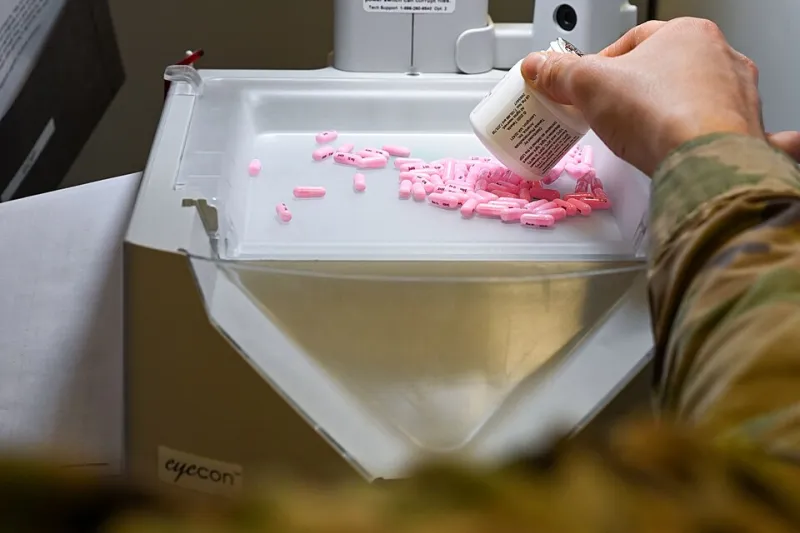
Photo: Joshua Nistas, Public domain, via Wikimedia Commons
The pitch shows up every fall, right around open enrollment: switch your maintenance meds to a 90-day supply and save. Sometimes that is genuinely true. Sometimes you pay three copays in January for a bottle you stop opening in March, and the savings evaporate before spring.
So let's treat the 90-day refill as what it is — a math problem, not a slogan.
The 30-second version
A 90-day fill usually wins when four things are true: you will still be taking the same drug at the same dose three months from now, your plan prices a 90-day fill at less than three times the 30-day copay, your deductible is already handled for the year, and the pills will not expire on your shelf. Miss any one of those and the bigger bottle can cost you more.
Where the larger supply genuinely wins
There are real savings here, and they are not marketing fluff.
- Copay discounting. Many plans charge 2 or 2.5 copays for a 90-day fill rather than a full 3. That is a straightforward 15-30% haircut on your share, every quarter, on every maintenance drug.
- Cash prices drop too. Big-box and warehouse pharmacies routinely post 90-day cash prices that undercut three 30-day cash fills. If you are paying out of pocket on a common generic — think metformin, lisinopril, atorvastatin — a 90-day cash fill is often the cheapest legal route to that molecule.
- Fewer counter trips. Not a dollar figure, but time off work and gas are real costs, especially for anyone managing three or four chronic prescriptions.
- Fewer gaps. A 90-day supply builds in slack if you travel, if the pharmacy runs short, or if a refill authorization takes a few days to sort out.
Where it quietly backfires
Your deductible resets in January
This is the big one. If you have a deductible you have not yet met, a 90-day fill in January can dump three months of full sticker price onto one receipt. Filling 30 days at a time lets you spread the deductible out — or lets you decide to pay cash for the first fill instead while the deductible stays untouched for something bigger. Ask the pharmacist to price both before you commit.
Copay tiers do not always scale cleanly
Some benefit designs charge a flat copay per fill regardless of fill length. Others charge per 30 days. A few specialty tiers flatten entirely. Two plans can look identical on the summary of benefits and behave completely differently at month three, so pull out the actual tier table.
Your dose might change
Dose adjustments happen constantly with thyroid meds, blood pressure drugs, diabetes drugs, and antidepressants. A 90-day bottle of 20 mg is dead weight if your prescriber moves you to 40 mg in five weeks. If you are in the first six months of a new medication, stay at 30 days until the dose settles.
The mail-order auto-refill treadmill
Auto-refill services are convenient until they keep shipping a drug you no longer take. Pills stack up in a drawer, and because the shipment was processed, the claim was billed. Turn off auto-refill until you are confident the therapy is stable, then turn it back on.
Expiration dates are finer than you think
Most solid tablets hold up well past the date on the bottle, but you should not rely on that when you are the one holding the receipt. If a 90-day supply will last you 120 days because you skip doses, the savings per fill get diluted fast.
Insurance 90-day versus cash 90-day
These are two different transactions and you should price both.
An insurance 90-day fill runs through your plan's benefit: it counts toward your deductible and out-of-pocket maximum, and it may come with a copay discount. The tradeoff is that you are locked into the plan's network and its formulary design.
A cash 90-day fill bypasses the plan entirely. On cheap generics, cash frequently beats a copay — a $10 or $15 generic copay tier is often undercut by a $4-$12 cash list price for a 30-day fill, and the 90-day cash price can land below $25. Here is the catch: cash fills do not count toward your deductible or out-of-pocket max. That matters enormously if you expect to hit your out-of-pocket limit this year, because a cash purchase does not help you get there.
Our rule of thumb: cash wins on inexpensive generics early in the year, insurance wins once you are working toward a meaningful out-of-pocket threshold or using a drug with a high list price.
The break-even checklist
Run through this before agreeing to a 90-day fill. Any 'no' means stay at 30 days for now.
- Same drug, same dose, for at least the next four months?
- Deductible already met, or this is a flat-copay tier that ignores the deductible?
- Plan charges less than three full copays for a 90-day fill?
- Confirmed you have no pending prescriber visit that could change the dose?
- Auto-refill off unless you deliberately turned it on?
- Compared the cash 90-day price to the insurance 90-day price, including whether the cash spend helps your out-of-pocket max?
- Storage sorted — no bathroom cabinet sauna, no car glovebox?
What to ask the pharmacy before you switch
Four questions, in this order:
- 'What would a 90-day supply cost me under my plan, and what would it cost as cash?' Get both numbers on the same visit.
- 'Does this count toward my deductible and out-of-pocket maximum if I pay cash?' You already know the answer; confirm it out loud so you remember it in June.
- 'Is the 90-day price discounted, or is it just three copays?' This separates real savings from a bigger receipt.
- 'If my dose changes next month, what is your return or exchange policy on the unopened portion?' Policies vary by state and chain. Ask before, not after.
The bottom line
The 90-day refill is a tool, not a default. It rewards patients with stable therapy, a met deductible, and a plan that actually discounts the larger quantity. It punishes anyone whose January deductible is wide open, whose dose is still moving, or whose mail-order box arrives long after the drug stopped helping. Price it both ways, ask the four questions, and let the arithmetic decide.